May 10, 2026 • Adaeze Okonkwo • 11 min reading time • Prices verified June 18, 2026
Plus-Size Swimsuit Tops Only: Mixing and Matching for Bodies That Need Different Sizes on Top and Bottom
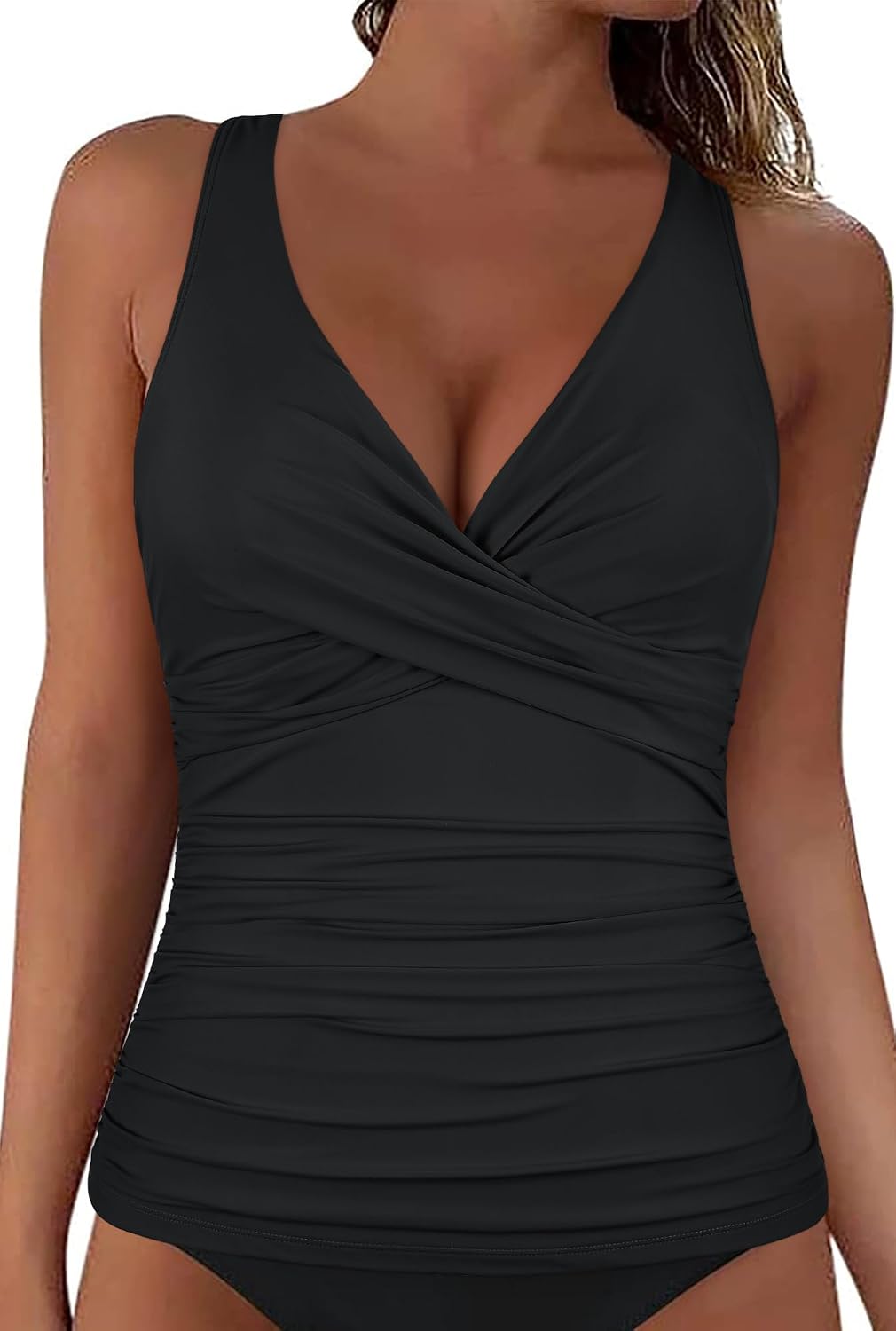
Plus-Size Swimsuit Tops Only: Mixing and Matching for Bodies That Need Different Sizes on Top and Bottom
Here’s a scenario that will feel immediately familiar to a lot of us: you find a swimsuit set you love, order your size based on your hips, and then spend the entire summer either spilling out of the top or hiking it up every five minutes because the cups are nowhere near your actual cup size. This is the core problem with buying swimwear as a coordinated set when your bust and your hips live in genuinely different size categories — what fits one end of your body simply does not fit the other. The good news is that the market for swimsuit tops sold separately has grown significantly, and the options now range from basic crossover tankinis to underwire-structured tops engineered for DDD-plus cups. This guide is organized so you don’t have to dig through 30 product pages to understand what’s actually different between them — we’ve pulled together the real-world sizing signals, the construction tradeoffs, and the specific fit quirks buyers keep flagging so you can land on the right top the first time.
Why Sizing Tops Separately Is an Engineering Problem, Not Just a Shopping Preference
Once you’ve accepted that your top and bottom will come from different places, the next challenge is understanding that swimsuit tops — unlike clothing — are sized along two axes simultaneously: band size (the measurement around your ribcage, just under your bust) and cup size (the volume difference between your full-bust measurement and your band measurement). Clothing sizes like 1X or 22W are approximations that collapse both into a single number, which is why they fail so many of us on top.
Shoppers who’ve cracked this consistently report the same advice: measure your band and your cup separately and cross-reference against the brand’s specific size chart before ordering. A reviewer of a twist V-neck style — a 44DDD wearing a size 22 — reported a perfect fit, which is a useful real-world anchor. That data point tells you the garment was constructed with enough cup volume at a 44-inch band to contain a DDD. That’s not information you’d get from a clothing size alone.
Glamour’s 2024 guide “How to Find a Swimsuit That Actually Fits a Larger Bust” reinforces this consistently: cup volume is the single most underdisclosed specification in plus-size swimwear, and brands that state their cup depth explicitly are doing buyers a genuine service.
By the numbers — what the band-plus-cup math means in practice:
- 44DDD = approximately 53 inches at the fullest point of the bust
- A 14-plus-inch differential between full bust and band equals a D cup or larger
- Most “plus-size” swim tops sized by clothing number max out at a C cup in cup-depth construction
- Tops explicitly engineered for DD-plus require reinforced underwire channels, wider strap attachment points, and deeper cup panels
The Four Top Silhouettes Compared: Support, Structure, and Fit Tradeoffs
Not all separated swim tops offer the same structural approach. Understanding which silhouette you’re looking at tells you a lot about what you’re trading off before you read a single review. The four main categories below are compared across support level, fit flexibility, and best-use scenarios. Each is terminated with a tier marker to help you navigate directly to the right option.
H3: Crossover V-Neck Tankini Tops
The crossover V-neck is the workhorse of this category. It wraps fabric across the bust in a diagonal pattern, creating a self-adjusting drape that accommodates a wider range of cup volumes than a fixed-panel top. The best examples of this silhouette avoid the two failure modes that plague cheaper crossovers: sagging at the center V and the visual bulk that reads as shapeless rather than elegantly draped.
The “purchased twice” signal from repeat buyers is one of the more credible durability indicators in this category, because it means the construction held through at least one full season of sun, salt, and chlorine exposure.
The tradeoff with crossovers: they are more adjustable but less structured. If you need firm containment rather than comfortable coverage, a crossover is a starting point, not an endpoint. This silhouette works best for DD cups and smaller, or for swimmers whose primary priority is style flexibility over maximum support.
 product image](/images/external/6cabd508c59b.jpg)
Talisea
$32.99
In stock on Amazon
Check price on AmazonH3: Underwire Tankini Tops
Underwire tops — tops with a rigid wire running beneath each cup to lift and separate the bust, mirroring the architecture of a supportive bra — are the gold standard for DDD-plus support in swimwear. Tops in this category are frequently described by reviewers as built for “very large bust and maximum coverage,” and that framing is useful for self-selection. If you need your swimwear to function at roughly the same level as your everyday underwire bra, this is the silhouette to prioritize.
The key construction detail to evaluate in any underwire swim top: where the wire ends meet the strap attachment point. This is the highest-stress location in the garment. Bartack stitching — a dense, tight zigzag of thread at junction points that prevents seams from pulling apart under load — at those wire-end attachment points is what separates tops that last a season from tops that last three. Who What Wear’s 2025 feature “The Best Swimwear Brands for Larger Busts” specifically calls out wire-end reinforcement as a meaningful differentiator in the large-bust category.
One specific fit issue worth flagging: some underwire tops in this silhouette fit correctly at the measured band size, but the side panel — the fabric between the cup and the armpit — is cut wide, leaving excess fabric. This is a meaningful pattern-grading problem. It means the cup volume and band depth are right, but the side panel wasn’t scaled proportionally. If you have a narrow-for-your-band torso, factor this in and look for tops with adjustable side ties or note whether the brand’s reviews flag the same issue consistently.
Good Housekeeping’s 2025 “Best Plus-Size Swimsuits” roundup notes that underwire swim tops work best when the band fits snugly at the ribcage — the band, not the straps, should carry the majority of the load.
Hilor
$35.99
In stock on Amazon
Check price on AmazonH3: Twist-Front Tops
The twist-front silhouette — fabric gathered and knotted at the center front of the bust, creating ruching that adds visual interest while managing fit through stretch — is increasingly popular in the larger-bust category because the gathering can absorb some cup-volume variation. Real-world fit data at 44DDD in a size 22W is a meaningful benchmark that many brands in the mid-price range can’t match, and twist-front tops at that size are among the more credible performers when cup-depth specs are disclosed upfront.
Twist-front tops are generally more coverage-forward than bikini-cut options, which makes them natural pairings for high-waisted bottoms without a gap at the midriff. The hem tends to run longer than on crossover styles, which is an advantage when you need reliable overlap with a high-rise bottom during movement.
The practical limitation: twist-front styles provide support through gathered compression rather than structured underwire, so at very large cup volumes — F cup and above — they function better as coverage garments than as primary support structures.
Hilor
$35.99
In stock on Amazon
Check price on AmazonH3: Removable-Pad Tops and a Material Warning
Several tops in this category include removable cup pads — soft foam or molded inserts inside the cup that can be taken out or left in. A recurring quality-control issue flagged by buyers: removable pads sold in some colorways are black. When the top gets wet, black pads show through lighter-colored fabric, including pink, white, and pale-toned shells. This is not a minor styling complaint — it is a transparency-under-water problem that affects wearability in daylight conditions.
Refinery29’s 2025 “The Best Bikini Tops for Big Busts” flags this as a recurring gap across the mid-range swim category. The practical rule: if you are ordering any swim top in a light color, verify that the removable pads are either the same color as the shell fabric or a neutral that will not read as a visible shadow when wet. If the product listing does not specify pad color, contact the retailer before ordering, or plan to remove the pads entirely and assess whether the cup structure holds its shape independently.
Firpearl
$35.99
In stock on Amazon
Check price on AmazonHow to Match a Separated Top with High-Waisted Bottoms
The pairing question matters as much as the top itself. If you are buying a swim top to mix with high-waisted bottoms — bottoms that rise to or above the natural waist, creating a longer covered midriff — top length becomes a fit variable you need to manage actively.
The length math works like this: A high-waisted bottom typically rises three to five inches above the hip measurement point. A tankini top that hits at or just below the natural waist will overlap that rise cleanly, covering the midriff without pulling or bunching. A top that hits at the hip will gap between the two pieces when you move or bend.
Good Housekeeping’s 2025 “Best Plus-Size Swimsuits” roundup recommends aiming for a tankini top with a hem that falls at or below the belly button when worn while standing. That gives you two to three inches of overlap with most high-waisted bottoms and eliminates the gap problem in motion. Twist-front styles tend to run longer in the hem than crossover or bra-cut options and are generally the safest pairing choice for high-rise bottoms.
Decision Framework: Which Top for Which Body and Priority
This is where we get direct, because the options above are not interchangeable.
If your primary need is volume accommodation for a DDD-plus cup at a 44-plus band: Start with underwire-structured tops and cross-reference the brand’s cup-depth specs explicitly. Real-world fit data at 44DDD is your benchmark — if a brand cannot provide it in their size chart or confirmed buyer reviews, they have likely not engineered the garment for that volume.
If your primary need is style flexibility and you are a DD or smaller: A well-constructed crossover gives you the adjustability to wear it across a range of outfit pairings without losing support. Look for the double-purchase signal in reviews as a durability proxy.
If you need a top that pairs with high-waisted bottoms: Prioritize tankini-length tops at or below the natural waist over cropped or bra-cut styles. Twist-front styles run longer and create the most reliable overlap.
If you are sensitive to liner visibility: Avoid light-colored tops with black removable pads. Either choose a top where pads match the shell, or remove the pads before your first wear and evaluate the cup structure on its own.
If you have a narrower-than-expected torso for your band size: Look for tops with adjustable side ties, and read reviews specifically for mentions of wide side panels or excess fabric under the arm — this is a pattern-grading issue, not a fit error on your part.
Frequently Asked Questions
Can an underwire swim top provide the same support as an underwire bra? A well-engineered underwire swim top can come close, but the elastic in swimwear fabric behaves differently than bra-specific elastics, and wire channels are typically wider to accommodate waterproof construction. Reviewers of structured swim tops at the DD-plus level consistently report adequate support for active beach use, but not the same precision lift as a fitted underwire bra. For very large cups — F and above — many fit experts recommend pairing a supportive swim top with a racerback or high-neck strap configuration to distribute weight across more attachment points. Good Housekeeping’s 2025 “Best Plus-Size Swimsuits” roundup notes that the band, not the straps, should carry the majority of the load in any well-fitting underwire top.
What size should I order if my band size and cup size point to different sizes? Measure your underbust for band size and your full bust separately, then use both numbers to cross-reference the brand’s dedicated swim size chart. If the chart shows your band size in a row where cup depth only goes to C, the top is not engineered for your cup volume regardless of what the clothing-size column says. Always prioritize the brand’s swim-specific size chart over general clothing-size guidance.
Will a black removable cup pad show through a light-colored swimsuit top when wet? Yes, consistently. Multiple buyers of light-colored tops with black pads report visible shadowing when wet, particularly in direct sunlight. If the product listing does not specify pad color, contact the retailer before ordering or remove the pads before your first wear and assess the cup structure on its own. Refinery29’s 2025 large-bust bikini top guide identifies this as a recurring quality-control gap in the mid-range swim category.
How long should a tankini top be to pair well with high-waisted bottoms? A tankini top hemline at or below the belly button — measured while standing — will overlap most high-waisted bottoms without gapping during movement. Tops that end at the natural waist or above tend to separate from high-rise bottoms when bending or swimming.
Is a crossover V-neck or an underwire tankini more supportive for a DDD-plus bust? For DDD-plus, an underwire top generally provides more reliable containment because the wire itself is doing structural work that a crossover drape cannot replicate. The crossover is more forgiving across a range of cup sizes, which is its primary advantage — but forgiving is not the same as supportive. At very large cup volumes, the underwire structure wins on function. Refinery29’s 2025 large-bust swimwear coverage consistently ranks underwire-inclusive tops above drape or crossover styles for cups DD and above.